About Me
The moment I thought about ditching my smartphone, I hit a wall of physical anxiety. It was a wake-up call. I’ve been tethered to a screen since I was ten years old, and that lifelong dependency has created a constant background hum of anxiety.
I’m tired of feeling controlled by the need to be perpetually connected. I want my life back. My solution is a radical reduction of digital devices. I am prioritizing stillness, solitude, and deep focus over the illusion of "achievement."
I’m trading the instant hits of dopamine and the ease of problem-solving for well-being and simplicity. I believe that there are questions I have about life that I can only answer through long periods of solitude and deep reflection.
Honestly, I don’t know where the screen ends and I begin. Everything I care about, buy, or strive for traces back to something I consumed online. My wants don’t even feel like mine. They were handed to me by the media I grew up with. There is a deep sense of detachment from my own goals because I recognize them as synthetic aspirations. Society bypassed my natural development of desire and fed it to me directly through a screen.

Honesty
I think one of the hardest things to do as a human is to be brutally honest. Not just with other people, but with yourself. I have struggled with this when I try to analyze what I am doing, why I am doing it, and what point it all serves.
I am not trying to get overly philosophical. I just want to lay out what I can remember and what I think is happening.
Why Do I Care About How I Live?
Because if you do not choose how to live, something else will choose for you.
Most people read that and think of explicit, puppet-style control. That is not really the point. Most systems are not trying to personally ruin your life. Your well-being is often just collateral damage in the pursuit of metrics and revenue.
1. Second-Order and Third-Order Consequences
In systems thinking, every action has a direct outcome, but it also creates a ripple effect:
- First-order consequence: A company creates a gambling-style scrolling system and makes more ad revenue.
- Second-order consequence: The user gets repeated dopamine hits and develops compulsive behavior around the app.
- Third-order consequence: The user spends less time in the physical world, feels isolated, and interpersonal skills degrade over years.
The people building these systems usually optimize for the first-order consequence. Most of the suffering lives in the second and third orders.
2. Negative Externalities
This is an economic term. An externality is a cost (or benefit) created by a producer that the producer does not pay for or receive.
- A factory can pollute a river to make cheap plastic while downstream communities pay the health cost.
- A tech platform can extract profit by keeping young users hooked, while users and society absorb the loss of time, attention, and healthy development.
3. The Attention Economy
Human attention is the commodity. Attention is finite, so companies compete aggressively to capture as much of it as possible. They are not always trying to control beliefs for ideology. They are mining attention so they can sell it.
4. Choice Architecture and Behavioral Design
This is not about force. It is about environment design. The way choices are presented strongly influences what people do.
When platforms combine variable rewards with low-friction interfaces, they make scrolling the easiest default behavior. They do not force the action. They tilt the floor so behavior rolls in one direction.
5. Surveillance Capitalism
Shoshana Zuboff popularized this term to describe a model where human experience becomes raw material for behavioral data. That data is used to predict and shape behavior for profit.
If you are not intentionally directing your life, these systems will direct it for you because your predictability is monetizable.
Example 1: The Pornography Ecosystem
Core mechanism: A platform is optimized for traffic and ad revenue while psychological costs are ignored.
- Catalyst (first-order): A frictionless free platform uses recommendation systems to push increasingly novel content and keep users clicking.
- Behavioral shift (second-order): Early exposure can hijack the reward system and build compulsive loops.
- Human cost (third-order): Real-world vulnerability and intimacy become harder, and isolation can feed the same coping loop that created it.
Example 2: The Social Media Attention Economy
Core mechanism: A platform turns attention into a tradable asset.
- Catalyst (first-order): Revenue ties directly to time in app, so teams implement infinite scroll and unpredictable notifications to drive compulsive re-engagement.
- Behavioral shift (second-order): Users get conditioned to open the app as soon as boredom or social anxiety appears.
- Human cost (third-order): People trade thousands of hours of lived experience for low-quality stimulation and weaker attention spans.
Why should I care if I'm Happy Doing this?
Are you actually choosing to do this, or are you just doing exactly what a corporation programmed you to do? If you spend your only free time on earth enriching a tech company because they figured out how to hack your biological reward system, you aren't living freely. You are being farmed. Being genuinely happy requires having the agency to choose your own path, rather than walking down a frictionless chute designed by a software engineer.
Caring about how you live matters because if you outsource your happiness to a corporation, they will sell you back a cheap, counterfeit version of it until you die.
The Architecture of Dependence
Neurobiology and Dopamine
Smartphones capitalize on "variable ratio reinforcement schedules," triggering dopamine releases in the brain's reward centers. The average person engages with their phone 144 times per day, often using the device as a "security blanket" to self-medicate against stress or anxiety.
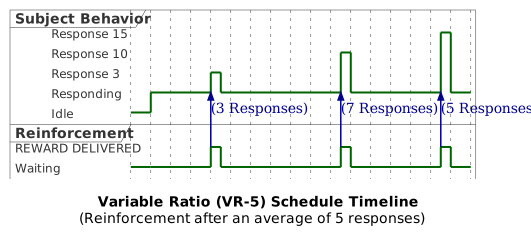
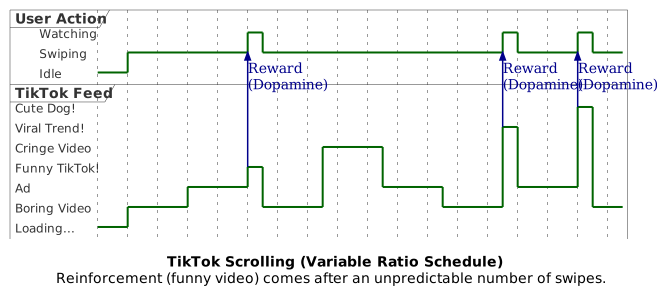
- The Ratio: You are rewarded based on the number of swipes (actions), not how much time passes.
- The Variable: You don't know if the funny video is 1 swipe away or 20 swipes away.
- The Effect: This creates a "Slot Machine" effect. The user keeps swiping constantly because the next one might be the winner.
The FoMO Cycle
Fear of Missing Out (FoMO) acts as a primary mediator between anxiety and problematic phone use. Research shows that when individuals are separated from their devices, anxiety spikes significantly if they can hear notifications but cannot respond, suggesting the device has become a literal attachment figure.
Rumination versus Mindfulness
Constant digital stimulation fosters a state of cognitive rumination, a repetitive, passive focus on distress. In contrast, mindfulness acts as a critical countermeasure. Digital minimalism forces the brain to transition from passive rumination to active presence.
The Illusion of Mandatory Connectivity
You are probably thinking to yourself, "I need my XYZ to be able to do ABC." This is cope. You are giving yourself an excuse to keep doing the addictive thing because you think having access to perform
The perception that smartphones are fundamental for modern existence is largely an illusion constructed by the convenience of centralized digital tools. You are not obligated to maintain a perpetual digital presence.
We often ignore crucial facts about our own lives to avoid learning about being an inauthentic person with an identity defined from outside the self. The pressure to sacrifice personal integrity, our moral values and aesthetic standards, in exchange for digital comfort is a high price for a hollow convenience.
You are not obligated to maintain a perpetual digital presence.
The compulsion to check correspondence is a distraction from meaningful engagement.
You have created an artificial requirement of having an internet/technological solution to solve a problem.
The Path Forward
What I am doing
- Using a Light Phone for essential calls/texts.
- Removing Optional Digital Tools: Any app or service that provides minor benefits but is not essential for daily functioning.
- Setting strict rules for necessary tools (e.g., work email).
- Replacing screen time with fitness, family, and craft activities. Might even find a tree to cut down.
"If you view data and stimulation the same way you view food, you see that most people are over-consuming information. Giving yourself solitude allows your brain to process and think."
FAQ
Why not just do a digital detox?
Digital detoxes are a Band-Aid on a bullet hole. They are a temporary solution to a deeper problem. You wouldn't tell someone suffering from overeating to stop eating for a week and then go back to overeating; you would find a sustainable diet.